The 5 Mistakes That Cost Texas Hold'em Beginners the Most Chips
A beginner can lose an entire stack without making one spectacular mistake. More often, the chips disappear through small decisions that feel harmless at the time: calling with a weak ace, refusing to fold from a bad position, or convincing yourself that the next card will save you.
Texas Hold’em gets much easier once you stop putting yourself in those spots. Here are five common beginner mistakes and a practical way to fix each one.
1. Playing Too Many Starting Hands
New players often treat folding as missing out on the fun. They look down at an ace or a face card and assume the hand is worth seeing a flop with.
The problem is that many weak starting hands make second-best one-pair hands—the kind that look decent but are often dominated when real money goes in. Take A7 offsuit. Sometimes it flops top pair, but that top pair can still be dominated by AK or AQ. On other boards, it may be up against two pair, a set, or a bigger made hand. Small disconnected cards have the same issue: once in a while they make something pretty, but most of the time they miss completely.
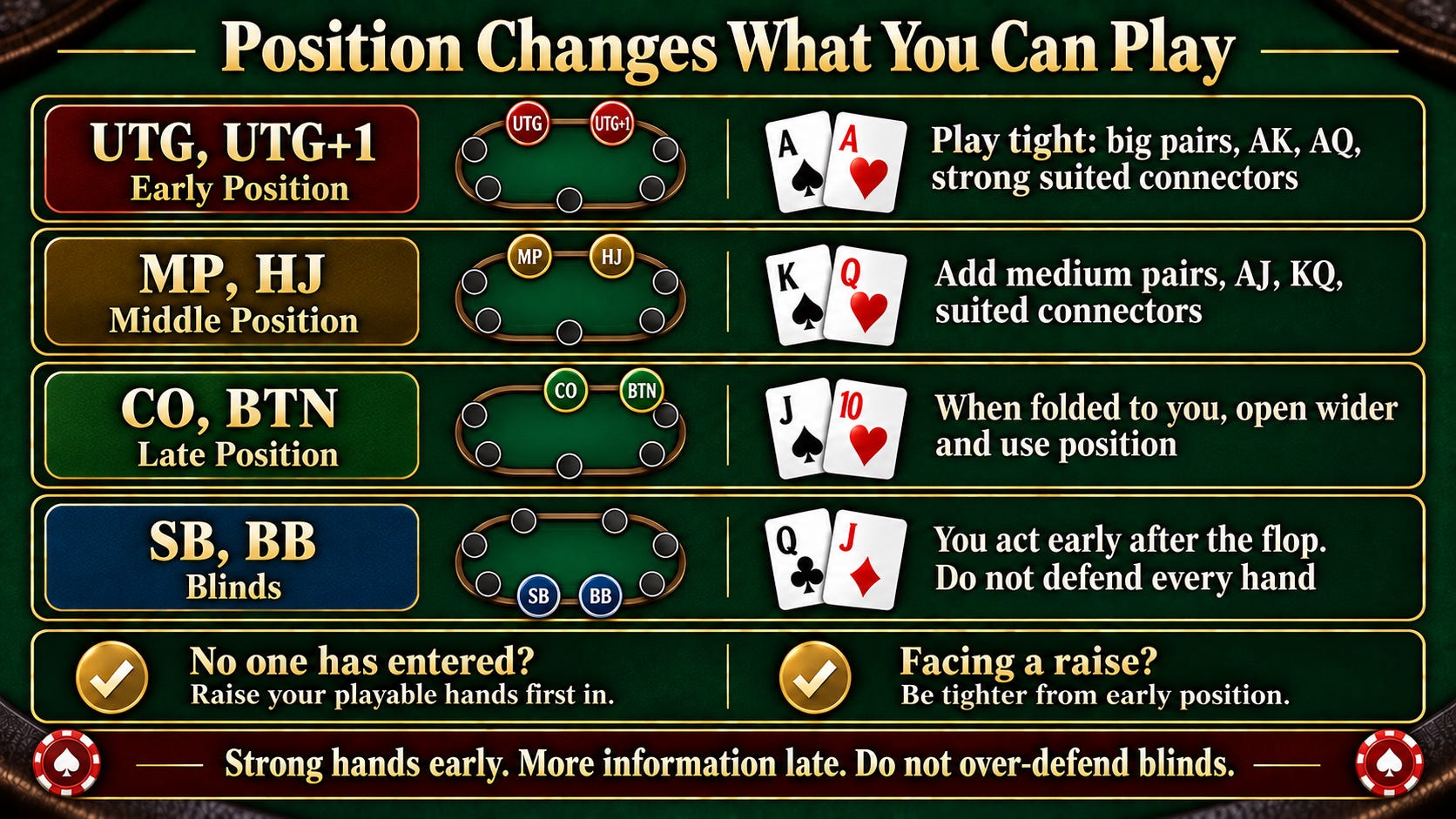
A useful beginner rule is to tighten up in early position, especially UTG and UTG+1. Favor big pairs, premium aces, and strong suited connectors. Folding a marginal hand before the flop does not cost you anything beyond the blind you may already have posted. Calling with it can create difficult decisions for the rest of the hand.
A7 offsuit is a good example. When an ace flops, top pair feels strong. But if an opponent keeps betting, they can easily have AK, AQ, or even AA. You did make a hand—but it is a hand that can lose a big pot.
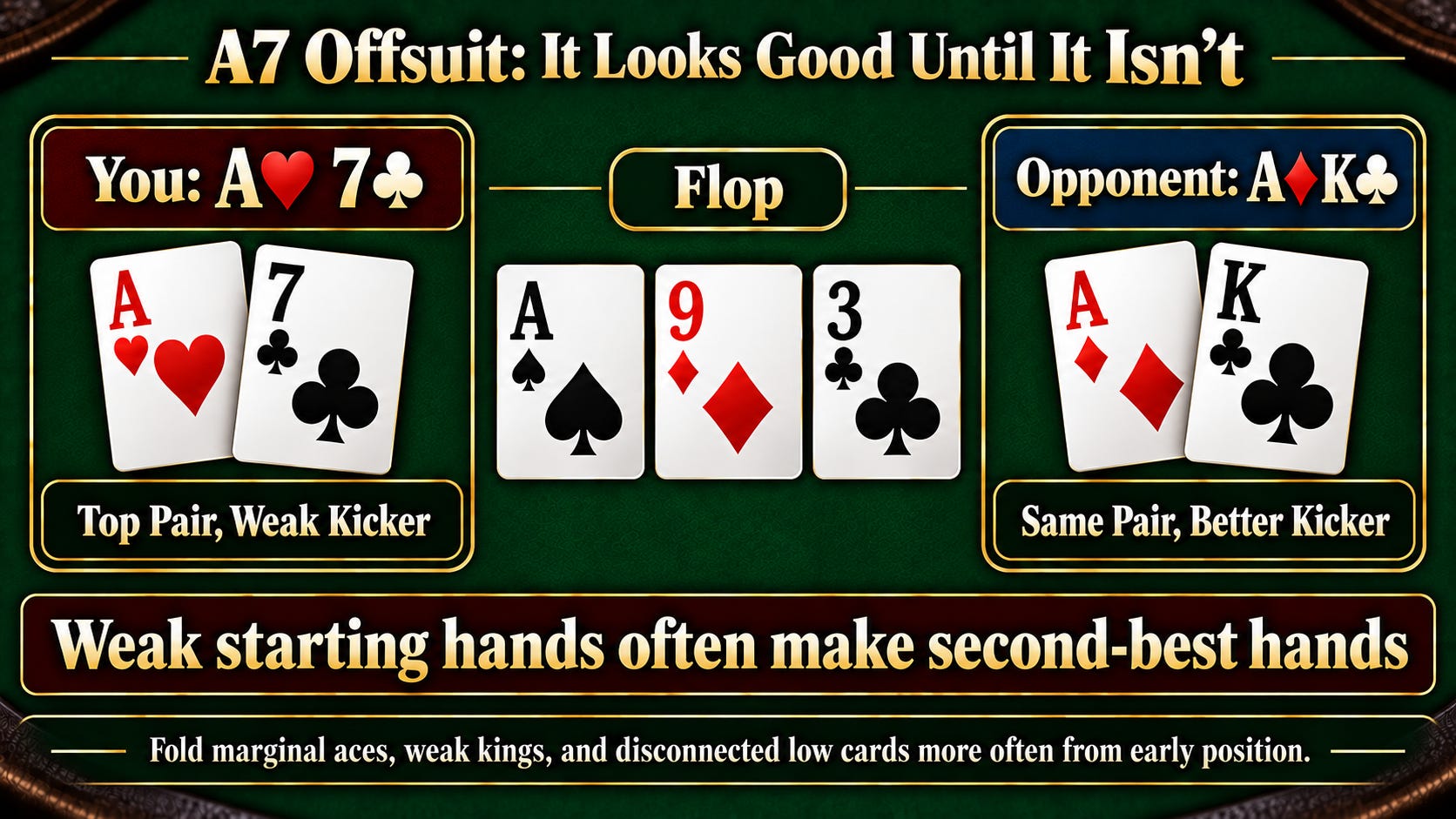
Playing too many hands also has three predictable costs:
You miss the flop more often. Random, low, offsuit hands rarely connect strongly, so blinds and small calls slowly leak away.
You face more difficult decisions. A weak pair, a low flush, or a marginal top pair can be hard to fold once you have invested chips.
Your strong hands become harder to recognize. When you enter pots with a tighter range, you will more often know where you stand with top pair, an overpair, or a strong draw.
Folding before the flop is not “missing an opportunity.” It is saving chips for a better one.
2. Ignoring Position
The later you act, the more information you have.
That is the practical value of position. Under the gun, several players can still enter or raise behind you, and you do not yet know what they intend to do. On the button, you have already seen most of the table act. You can see whether everyone has folded, whether someone has limped in, or whether the pot has already been raised.
KJ suited makes the point well. If everyone folds to the button, opening it is usually reasonable. In early position at a full-ring table, you should be more selective because stronger aces, kings, and pairs are still behind you. In six-max, KJ suited is generally a normal open, but it is still easier to play when you have position after the flop.
Position does not change your two cards. It changes how safely and profitably you can play them. When in doubt, play tighter early and give yourself more room to act later.
3. Not Knowing the Hand Rankings Cold
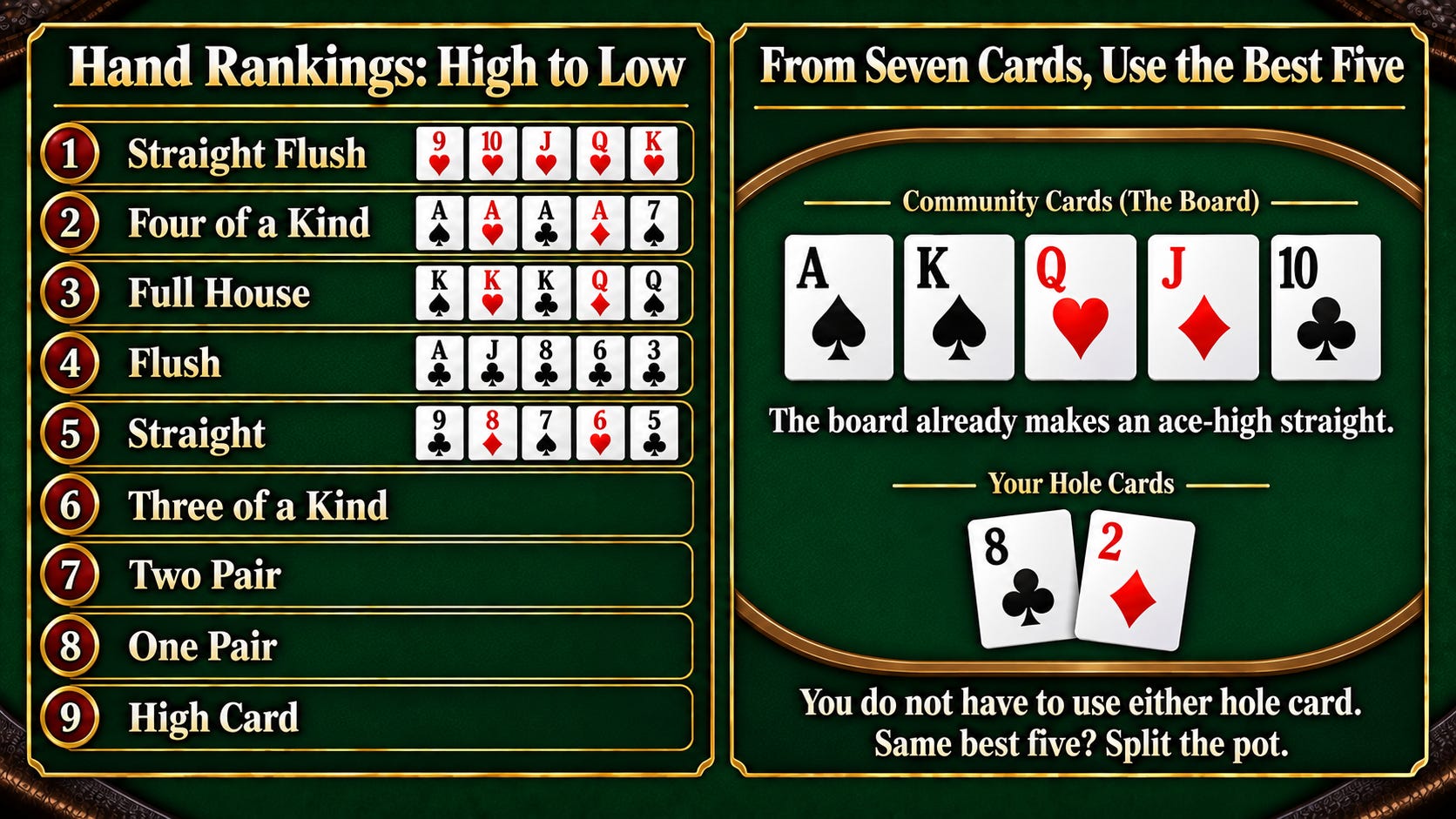
This is basic, but it matters. You do not want to reach showdown and suddenly wonder whether a flush beats a straight, whether a full house beats a flush, or whether four of a kind beats a full house. One bad read of the board can turn a clear fold into an expensive call.
Another common mistake is forgetting that Texas Hold’em uses the best five cards from the seven available cards. You do not have to use both hole cards. Sometimes the board supplies most of your hand. In rarer cases, the board plays for everyone: if the five community cards are the best possible hand for every remaining player, the pot is split.
Learn the hand-ranking order first, then learn the comparison rules that cause the most confusion. When two players have full houses, compare the three-of-a-kind first; if that is tied, compare the pair. When both have a flush, compare the highest card, then the next highest card if needed.
I maintain a free Texas Hold’em hand rankings chart that puts the full order and the most commonly confused comparisons in one place.
4. Letting Your Bet Size Reveal Your Hand
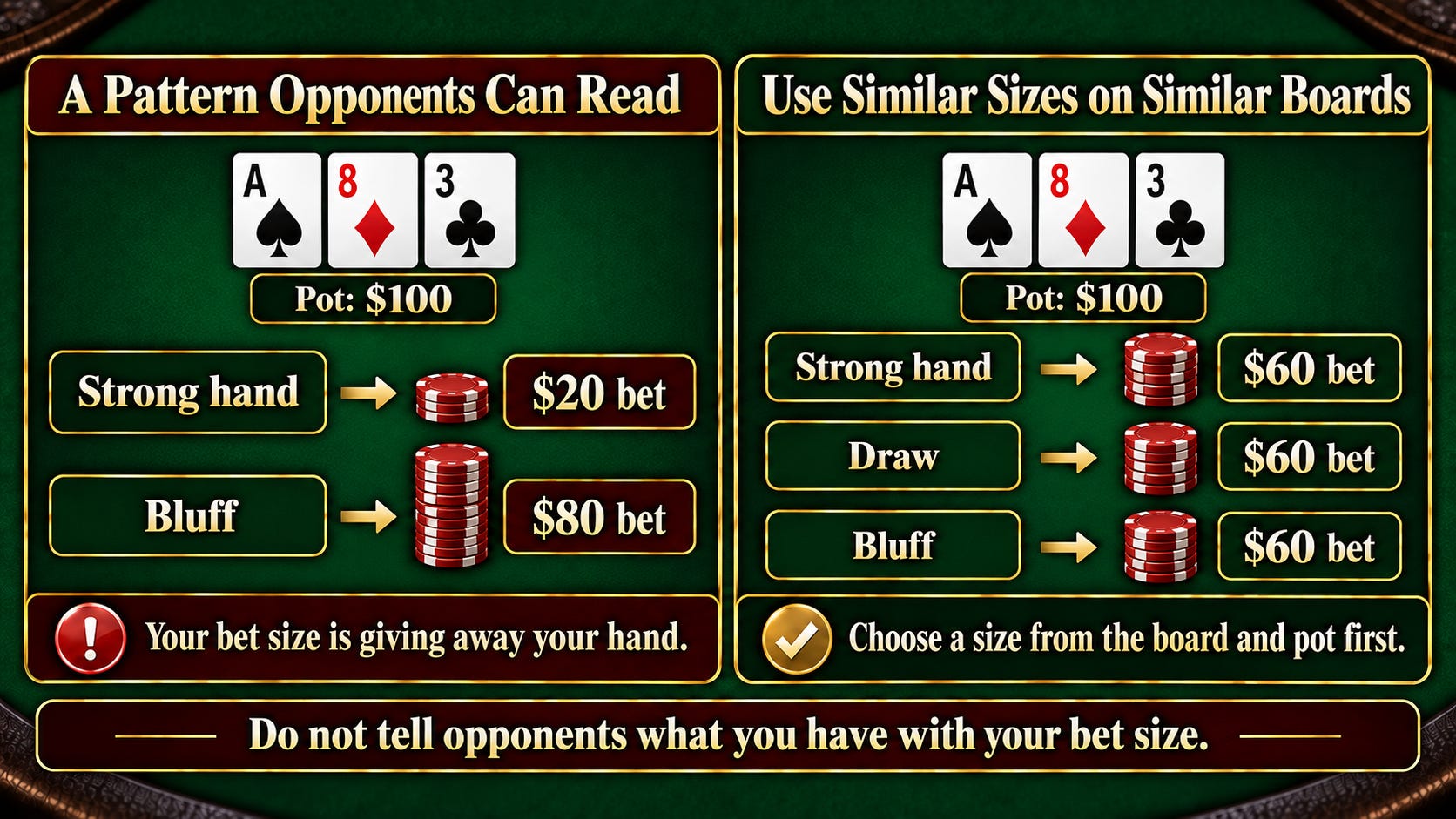
Some beginners bet tiny when they want a call, then suddenly bet large when they are afraid of being called. After a few hands, observant opponents notice the pattern.
You do not need a complicated betting system in a casual game. A simple approach is usually better: on similar board textures, use similar bet sizes with strong hands, draws, and bluffs. That makes your actions harder to read.
For example, if you only make a small bet with top pair and only make a large bet when you miss and bluff, your sizing is giving away more information than your cards are. Start by choosing a reasonable size based on the board and the pot. Then decide whether your hand should bet, check, call, raise, or fold.
5. Chasing Draws at the Wrong Price
A flush draw or straight draw can feel very close. That feeling makes beginners think they should call no matter how much an opponent bets. But a draw is not automatically worth chasing.
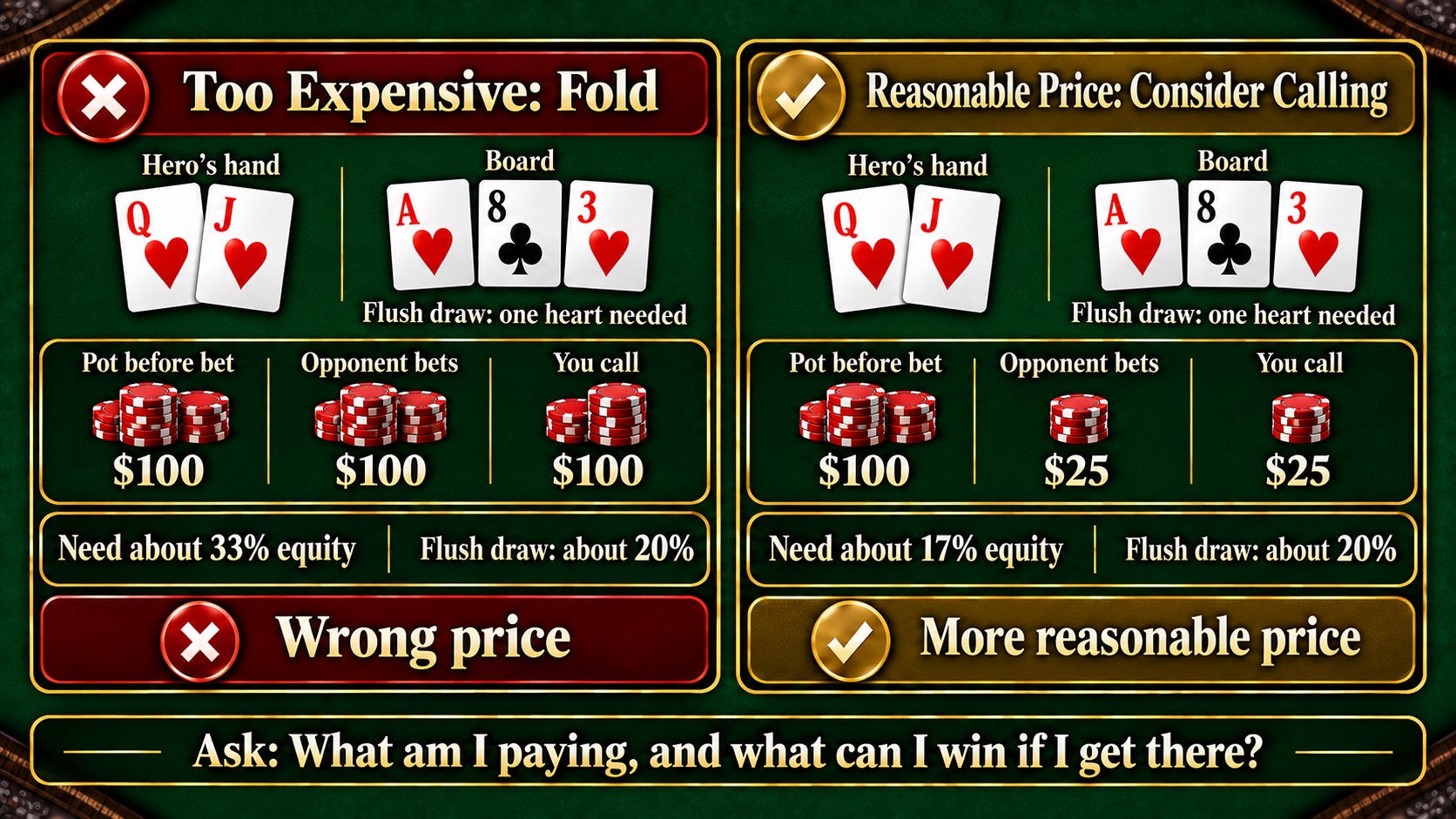
Before calling, ask two questions: how much am I paying, and how much can I win if I make my hand? Pot odds are simply a way to compare the price of a call with the chance that your draw gets there.
You do not need to calculate every percentage perfectly when you are new. Start with the habit of noticing whether the opponent’s bet is very large compared with the pot. If the price is high and you only have a draw, folding is often the disciplined choice.
For example, with one card to come, a normal flush draw has roughly a 20% chance of improving. Calling $100 into a $100 pot requires about 33% equity, so the price is poor if there is no extra money to win later. Calling $25 into that same pot only requires about 17%, which is much more reasonable.
Poker rewards patience more often than hope. One more card can feel like a chance to turn everything around, but that feeling alone is not a reason to put more chips in.
When you are starting out, the goal is not to play perfectly. It is to avoid the repeated mistakes that quietly cost chips: know the hand rankings, respect position, and be willing to fold when the situation does not support a call.
If you want a reference beside you at the table, I maintain a free printable poker cheat sheet with hand rankings, starting hands, betting rounds, and basic pot-odds guidance in A4, US Letter, and pocket formats. I built Flopkit as a practical reference for new Texas Hold’em players who want the basics in one clear place.
Comments
Post a Comment